AI Detection and Response
Incidents move fast. Your context should too
Automate the first-response work your L1 and outsourced teams do by hand. BigPanda separates real incidents from noise, triages them with full context, and resolves them or routes them to the right team.
Take control of incidents before they escalate

Fewer incidents
“Not only can we see the alerts, but we can evaluate them using correlation that recognizes patterns, connects alerts and leads to fewer incidents.”
Gamma

Faster problem resolution
“Adding context to enrich alert data leads to more effective prioritization, faster problem resolution and fewer service disruptions.”
Bloor

Significantly reduced MTTR
“BigPanda has enabled us to get more real-time, relevant data about a specific incident. This has significantly reduced our mean time to resolution (MTTR).”
WEC Energy Group
Smarter detection. Faster triage. Fewer escalations.
Complete, correlated context from the moment an incident is detected, and an L1 Agent that acts on it, so routine incidents resolve on their own and the rest reach the right team.
In the product
Triage that runs on its own
An alert comes in. AI agents investigate, read-only, and post what they found.
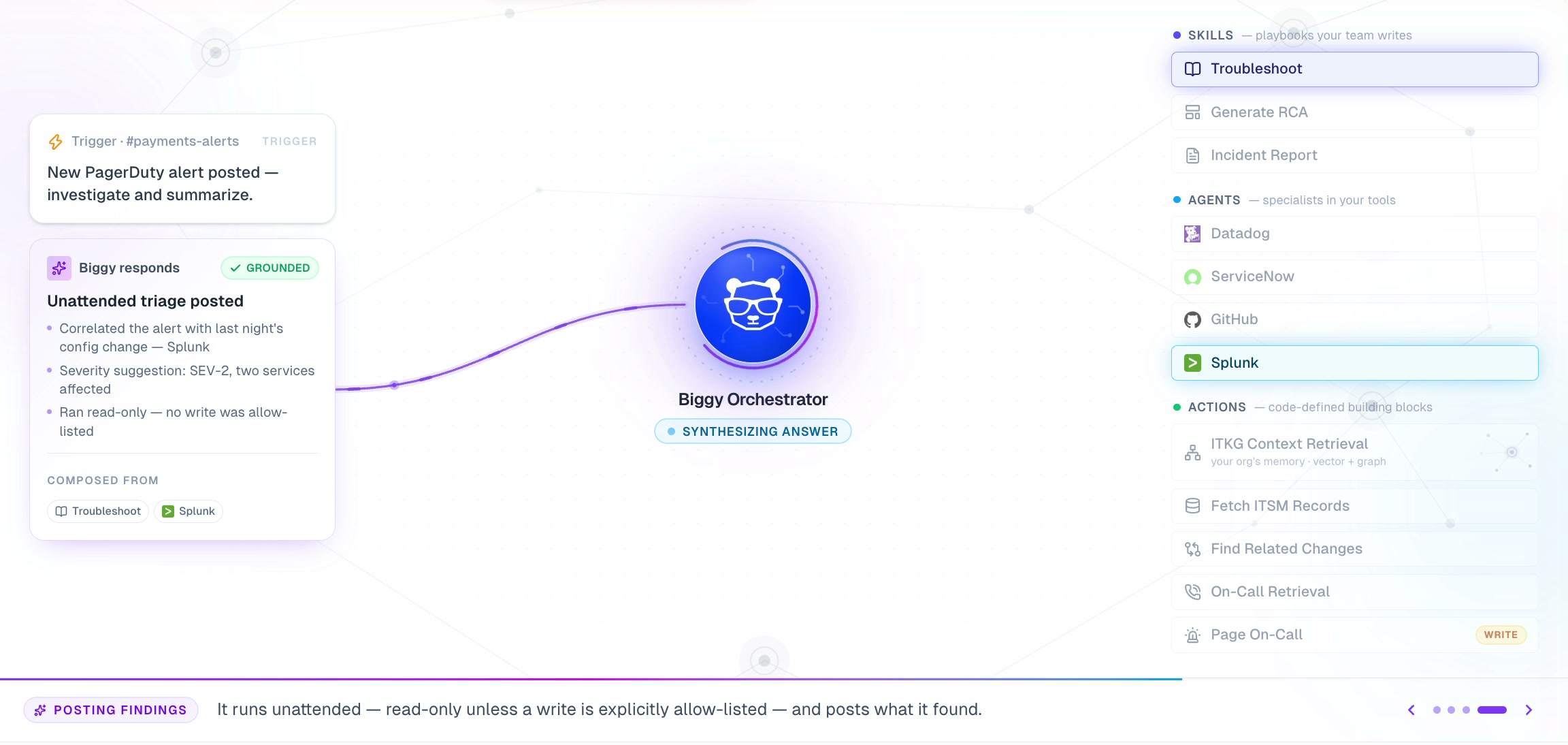
Automate L1
Outsourcing scales capacity, not effectiveness
Alert volume grows every year, and outsourced L1 contracts grow with it. The work still runs on manual handoffs, by people with even less knowledge of your environment. BigPanda replaces that model with an L1 Agent that absorbs the repeatable work.
Lower operating costs
Reduce outsourced L1 spend and avoid adding headcount while you support more services, applications and infrastructure.
Fewer escalations
L1 has the context and next steps to resolve or route incidents correctly, so senior engineers spend less time firefighting.
Protected revenue
Actionable incidents are found, understood and routed before customers feel the full impact, with fewer SLA misses.
Learns and acts, not just reduces noise. Most event intelligence tools stop at correlation, and every incident still lands on a person to investigate and route. The BigPanda IT Knowledge Graph learns what actually happens during incidents, who really resolves them and which fixes work, so L1 triage gets more accurate and autonomous action earns trust over time.
L1 assessment
See where your L1 stands before you change anything
Find out how your monitoring tickets are handled today, and how much of that work the L1 Agent could take on: routing, noise and runbooks.
- 1Bring your tickets and runbooksStart from your monitoring ticket history and the runbooks and SOPs your team already wrote, as they are today. Nothing changes in your NOC.
- 2See where you standTime to acknowledge, assign and resolve. How often tickets bounce between teams, how much is noise, and which runbooks match real incidents.
- 3Pick what to automate firstSee what the L1 Agent can take on today, from routing and suppression to the runbooks it can run, and what the rest would need.
What the report shows
- Ticket volume, and which tools create the tickets
- Time to acknowledge, assign and resolve
- How often tickets bounce between teams
- Duplicates and noise that could be suppressed
- Which runbooks match your real incidents
- Which runbooks can run today, and which need more access
Integrations
On everything you already run
Correlated context from monitoring, cloud, ITSM, change and collaboration tools, connected once.
100+integrations, connected once










































































Signals in from monitoring, cloud and change. Actions out to on-call, chat, ITSM and automation.
All integrations →FAQ
What types of data can I integrate into BigPanda?
The BigPanda IT Knowledge Graph can ingest data from many internal and external sources, including monitoring and observability tools, historical incident records, knowledge bases, runbooks, external observability and service desk tickets.
How does BigPanda provide additional context for enterprise ITOps?
BigPanda enriches incidents with relevant context by ingesting and normalizing data from diverse sources, including topology, CMDB and change integrations. Multidimensional alert correlation and AI incident analysis give your teams deeper insights and automate root cause analysis (RCA). AI agents gather relevant information from historical incidents, recent changes, external observability, service desk tickets and other ongoing incidents, then summarize it, so teams see how systems connect and resolve incidents more efficiently.
What is external observability?
Monitoring and observability tools often miss alerts caused by external factors, such as power outages and weather events. BigPanda integrates alerts from external sources, such as social media monitoring, power and weather outage reports, and the status pages of cloud providers and third-party SaaS applications. We call this external observability. It helps teams expand their visibility and eliminate blind spots.
Do the AI agents learn and adapt?
Yes. AI agents recommend remediation steps based on incident context, drawing on your institutional and informal knowledge, even when it is undocumented. The system learns from previously resolved incidents over time, improving the accuracy of triage suggestions and reducing unnecessary escalations.
Does BigPanda AI Detection and Response have agentic workflows?
Yes. When an incident occurs, AI agents gather and analyze relevant data across other ongoing incidents, service desk tickets, external observability, change correlation and historical incidents. The result is an AI-generated incident summary with clear, suggested actions, giving responders immediate situational awareness and a confident starting point for triage.
Demo
See BigPanda AI Detection and Response in action
Bring a recent incident. We’ll show you the context your responders would have had from the first alert.