BigPanda AI SRE
The AI SRE that knows your whole environment
Most AI SREs start from one service’s telemetry. BigPanda’s AI agents start from what your organization already knows — every change, owner and past fix — and run the incident from page to postmortem.
Enterprise incidents don’t stay in one service
The cause is usually somewhere else.
A change, a dependency or a third party, owned by another team.
Nobody sees the whole picture, so everybody joins the bridge.
Knowledge lives across monitoring, tickets, changes and people's heads.
Your experts do dispatcher work.
Finding owners, paging, chasing and writing updates, instead of fixing.
Same incident. Two investigators.
Illustrative“Error rate is up on payments-api. Want me to look at the logs?”
“Card payments are declining for EU customers on payments-api and two dependents. Seen three times since July, same fix each time. CHG0057 changed the payments-db connection pool 14 minutes before onset. Paged the database team’s on-call. Rollback attached, waiting for approval.”
The difference is the context, not the model.
How the AI SRE investigates
Dozens of agents chase every lead. The evidence picks the cause.
Each lead gets its own agents checking metrics, logs, changes and past incidents. Leads that don’t hold up drop out. The one the evidence supports moves to the centre, and you see why.
Checkout latency for EU shoppers
Illustrative- Minute
- 1
- Agents
- 18
- Active leads
- 6
- Evidence
- 8
- payments-db connection pool exhausted after CHG-1042Exploring
- Consumer lag on orders-eventsExploring
- CDN edge errors in eu-westExploring
- Memory leak in checkout-web v2.18Exploring
- Rate limiting from fraud-checkExploring
- DNS timeouts from the payment gatewayExploring
Know. Run. Prevent. Automate.
One AI SRE for the whole incident lifecycle, built on what your organization already knows.
Know
Start from what your organization already knows
BigPanda builds operational knowledge from the systems you already run: changes, tickets, the CMDB, ownership, on-call, runbooks and past incidents. Every incident writes back, so the next one starts further ahead.
Includes: IT Knowledge Graph · integrations · change and incident history · runbooks and memory
Run
Run every incident from page to postmortem
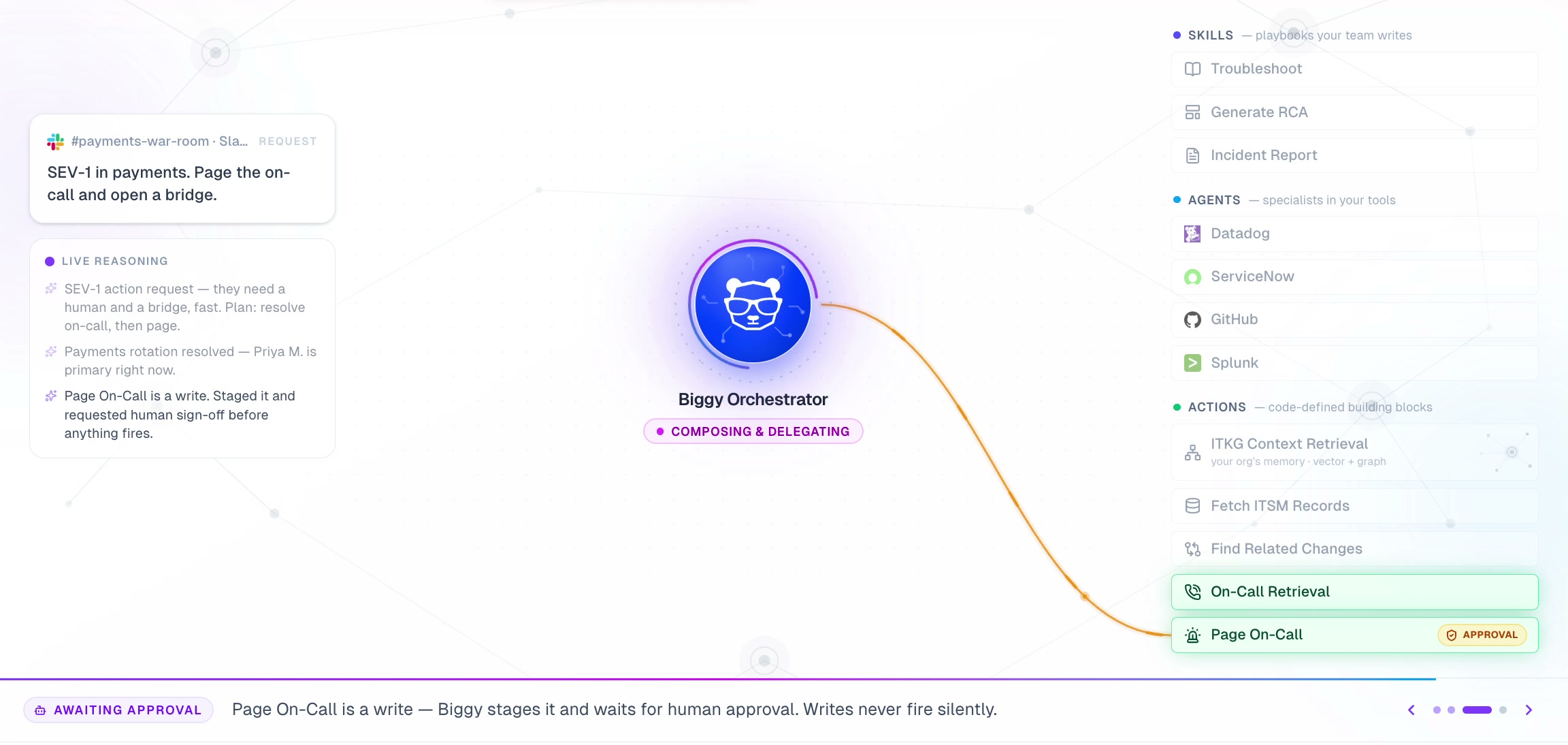
Page the owner who can fix it, keep the bridge small, investigate every domain in parallel and keep every audience updated. Fixes run once a person approves, and the postmortem is drafted from the record.
Includes: Incident orchestration · Swarm investigation · On-call (new) · remediation with approval
Prevent
Stop the next incident before it ships
Score every change against your environment's history before CAB, and trace repeat incidents to a shared cause so they're fixed once.
Includes: Change intelligence · Problem intelligence
Automate
Put the engineering back in SRE
Hand repeat tickets, health checks and shift turnover to automation and team agents your SREs own. The week goes back to building.
Includes: Operational automation · AI agent studio
A team of AI agents, working under your rules
A team of AI agents that know your environment, work the incident together and act only as far as you allow.
Grounded.
Every agent works from the same operational knowledge, not one tool's telemetry.
Coordinated.
Agents split the work: paging and briefing, investigating each domain in parallel, updating every audience, writing the postmortem. One incident, one record.
Governed.
You decide what each agent may do, per task and per asset. Every action carries the agent's ID and the approver's name.
Yours to extend.
Teams build their own agents from their runbooks, on the same knowledge and under the same rules.
3 in 10
the incident causes we found in a change record
almost 1 in 4
the causes that sat in no observability tool at all
From 254 graded incidents at nine enterprise customers, October to November 2026. That’s the context a single-service AI SRE never sees.
major incidents 20–37% shorter
A global tech-protection and insurance services company and a large US integrated healthcare provider
response teams together in 5–8 minutes instead of 30
A Fortune 500 healthcare diagnostics company
bridges down from up to 100 people to 15 or fewer
A Fortune 500 healthcare diagnostics company
Autonomy you dial up
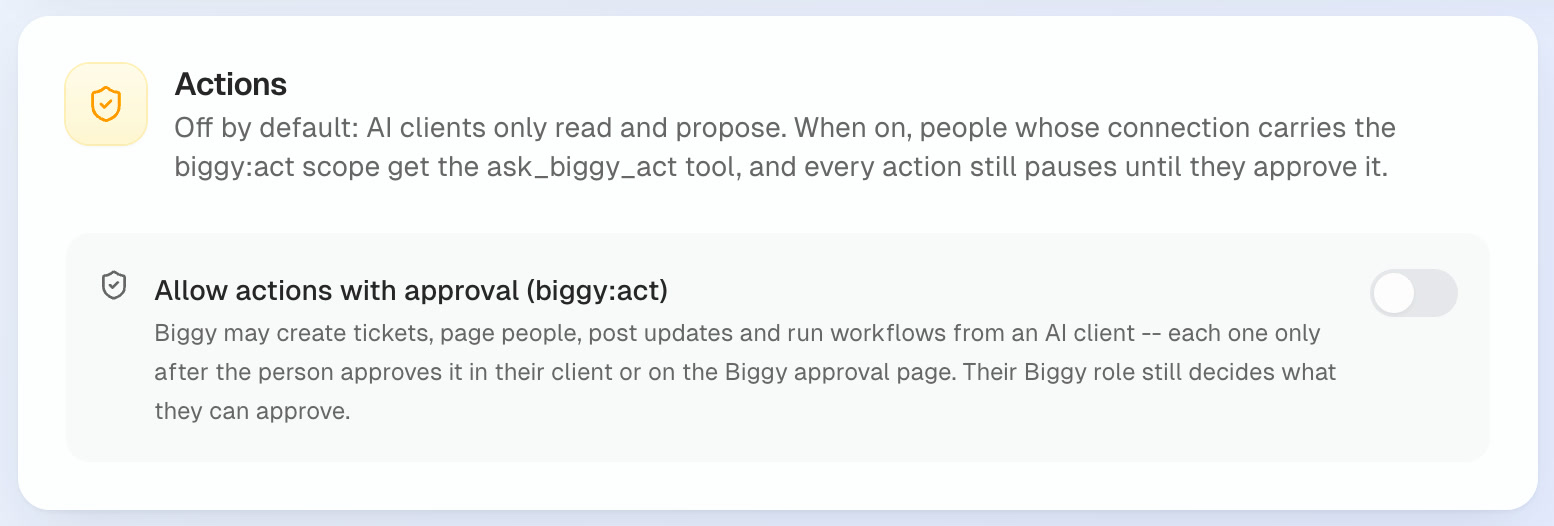
Start read-only. Then set each task and each asset to recommend, approve or autonomous, and raise it as trust is earned. Every action is on the record and exports to your audit system.
- Recommend: the agent proposes, a person acts
- Approve: it runs once a named person confirms
- Autonomous: it acts inside its scope, and people are informed
Works with the tools you already have
BigPanda connects to your ITSM, paging, chat and observability tools, then works where your teams already work.
 ServiceNow
 PagerDuty
 Opsgenie
 Slack
 Microsoft Teams
 Datadog
 Dynatrace
 Splunk
 Confluence
Prove it on your own incidents in 30 days
Agree on one outcome and the exit rule before we have access. We replay your past major incidents, then shadow live ones. On day 30 you decide on the scorecard you signed.
FAQ
What is an AI SRE?
An AI SRE is an AI agent, or a team of agents, that helps site reliability engineers detect, investigate and resolve production incidents. Most AI SREs start from telemetry and code. BigPanda AI SRE also starts from operational knowledge: owners, changes, history and past fixes.
How is BigPanda AI SRE different from other AI SRE tools?
Most AI SRE tools are built for one service: its logs, metrics and code. BigPanda starts from what your whole organization knows, and it runs the incident itself (paging, the bridge, updates and the postmortem), not just the investigation.
Does it work with ServiceNow?
Yes. BigPanda reads ServiceNow incidents, changes and the CMDB as part of its operational knowledge, and writes the incident record back.
Does it take actions on its own?
Only as far as you allow. Every task starts at recommend or read-only. You can raise each task and asset to approve or autonomous over time, and every action is recorded with the agent and the approver.
Which tools does it connect to?
ITSM, paging, chat, observability and knowledge tools, including ServiceNow, PagerDuty, Opsgenie, Slack, Microsoft Teams, Datadog, Dynatrace, Splunk and Confluence.
How long does it take to get started?
Out-of-the-box capabilities run within days once access to your tools is granted. Most POVs run for 30 days on your own incidents.
How is it priced?
On BigPanda credits, with a cap, and the cost of each run is shown before a team turns it on.
We use Opsgenie. What happens at end of support?
BigPanda On-call handles schedules, policy-based paging and escalation, and it works alongside the rest of BigPanda AI SRE.
See what your AI SRE would know
Bring one recent major incident. We’ll show you the change, the owner and the fix BigPanda would have started with.